
 As a part of a special issue of the university journal Forum dedicated to 670th anniversary of Charles University foundation, Jakub Trubač, EGG-member and head of Stable and Radiogenic Isotope Laboratory, was interviewed as a representative of Faculty of Science. He starts with the citation of one of his teachers, Dr. Fratišek V. Holub, who said: “Rocks are the only solid basis of our world”:-) Enjoy the interview on pages 52-53 of the electronic document (link).
Thallium in polluted desert soils
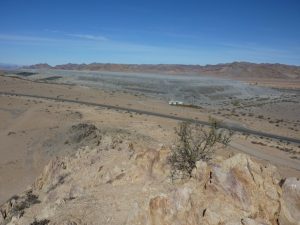 A combination of multiple techniques including XAS and isotopes helped to decipher the mobility of Tl in mining-polluted desert soil in Namibia. Mechanical transport of fine particles of post-flotation tailings is probably responsible for Tl dispersion in soil profiles.
Grösslová Z., Vaněk A., Oborná V., Mihaljevič M., Ettler V., Trubač J., Drahota P., Penížek V., Pavlů L., Sracek O., Kříbek B., Voegelin A., Göttlicher J., Drábek O., Tejnecký V., Houška J., Mapani B., Zádorová T. (2018): Thallium contamination in desert soil in Namibia: Chemical, mineralogical and isotopic insights. Environmental Pollution 239, 272-280. (DOI)
Transformation of copper smelter flue dust in contrasting soils
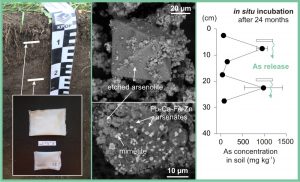 A first long-term (2 years) field experiment indicated how As and other metal(loid) contaminants can be released from As-rich copper smelter flue dust after deposition in contrasting soils. Up to 72% of As was leached out from the flue dust after incubation. The majority of As became highly mobile and could represent a risk for individual environmental compartments (soil, water).
Jarošíková A., Ettler V., Mihaljevič M., Penížek V., Matoušek T., Culka A., Drahota P. (2018): Transformation of arsenic-rich copper smelter flue dust in contrasting soils: A 2-year field experiment. Environmental Pollution 237, 83-92. (DOI)
Copper isotopes in tree rings discriminate sources of pollution
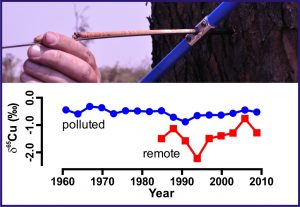 We published first Cu isotope data in pine tree rings and surrounding polluted and unpolluted soils in the Zambian Copperbelt. In highly polluted soil profiles, there is greater Cu isotope fractionation and Cu isotope compositions in tree rings indicate that there was a non-root uptake of Cu uptake by the trees.
Mihaljevič M., Jarošíková A., Ettler V., Vaněk A., Penížek V., Kříbek B., Chrastný V., Sracek O., Trubač J., Svoboda M., Nyambe I. (2018): Copper isotopic record in soils and tree rings near a copper smelter, Copperbelt, Zambia. Science of the Total Environment 621, 9-17. (DOI)
Alice Jarošíková defended her PhD
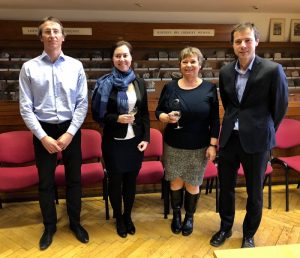 On Friday February 3, 2018, Alice Jarošíková defended her PhD entitled “Experimental in situ transformation of smelting wastes in soils”. On the photo, where she is second from the left, you find her together with two reviewers Prof. Edgar Hiller (Comenius University, Bratislava) and Prof. Barbora Doušová (Institute of Chemical Technology, Prague) and her supervisor, Prof. Vojtěch Ettler. Congratulations, Alice!
Biologically induced formation of realgar
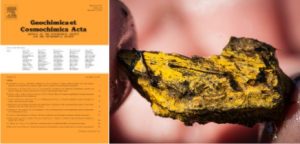 Check the great paper by Petr Drahota and co-authors about low-temperature formation of As sulphides, which has just been published in GCA! Drahota P., Mikutta C., Falteisek L., Duchoslav V., Klementová M. (2017): Biologically induced formation of realgar deposits in soil. Geochimica et Cosmochimica Acta 218, 237-256. (DOI).
Special issue of European Journal of Mineralogy dedicated to Zdeněk Johan (1935-2016)
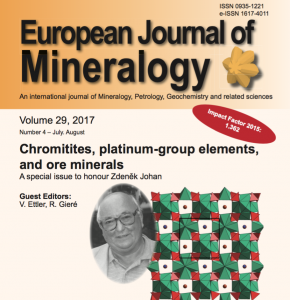 Special issue of European Journal of Mineralogy dedicated to Dr. Zdeněk Johan (1935-2016), our former close collaborator and friend and a world-famous mineralogist, has just been published. This special issue was co-edited by Vojtěch Ettler and contains 20 excellent papers. (www)
Short course on stable isotopes by Dr. Nikolai Pedentchouk (University of East Anglia) – April 18 and 20, 2017
 Dr. Nikolai Pedentchouk from University of East Anglia (UK) gave a short course on Stable Isotopes in Earth Sciences on Tuesday, April 18 and 20, 2017. Lectures were supplemented with practical sessions in our isotope lab. Program included fundamentals of light isotopes and systematics of C, O and H isotopes.
First thallium isotope data from our new Neptune MC ICP MS just published in ES&T
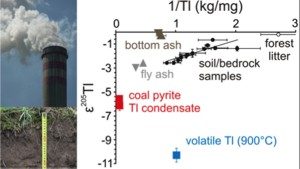 We studied how thallium isotopes can be used for tracing anthropogenic pollution in soils contaminated by emissions from coal-fired power plants. These results are the first published isotope data generated by our brand new MC-ICP-MS lab. Vaněk A., Grosslova Z., Mihaljevič M., Trubač J., Ettler V., Teper L., Cabala J., Rohovec J., Zadorova T., Penizek V., Pavlu L., Holubik O., Nemecek K., Houska J., Drabek O., Ash C. (2016): Isotopic Tracing of Thallium Contamination in Soils Affected by Emissions from Coal-Fired Power Plants. Environmental Science and Technology 50, 9864-9871. (DOI)
Brand new determination of thermodynamic properties of arsenates
 In the footsteps of previous research on zýkaite (Majzlan J., Amoako F.Y., Kindlová H., Drahota P. (2015): Thermodynamic properties of zýkaite, a ferric sulfoarsenate. Applied Geochemistry 61, 294-301, DOI) we published in Hydrometallurgy new thermodynamic data for FeAsO4·0.75H2O: Majzlan J., Dachs E., Benisek A., Drahota P. (2016): Thermodynamic properties of FeAsO4·0.75H2O – a more favorable disposable product of low As solubility. Hydrometallurgy 164, 136-140 (DOI).